 By KEN KORCZAK
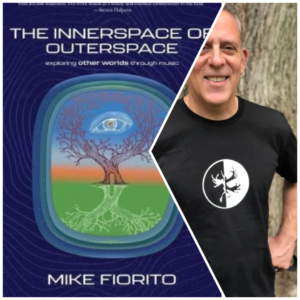
Author Mike Fiorito pens a hyperdimensional analysis of music enlisting undertones of ufology, psychedelic vision, Tarot, Qigong and more
I will start by revealing something intriguing about Mike Fiorito’s latest book, The Inner Space of Outer Space, but first I want to tell you about an innovative technique the late, great science fiction writer Philip. K. Dick used to pen his breakout science fiction novel, The Man in the High Castle.
Get this:
Always an outside-the-box thinker, Philip K. Dick was deeply intrigued by the I Ching, the ancient Chinese divination text. It was first rendered as text in about 1,000 B.C. The I Ching is also called “The Book of Changes.”
In the early 1960s, Dick conceived the brilliant idea of using the I Ching to inform, plot, and guide the narrative of his new novel. For example, whenever Dick came to a point where his plot bogged down or he “got stuck,” he “threw the yarrow sticks” to generate one of the 64 distinct hexagrams of the I Ching.
Dick then interpreted the “Judgement” of the hexagram to determine what should happen next in his story. Dick also used the I Ching to determine the motivations of each of his fictional characters as well as to inform the overarching theme of his book.
The Man in the High Castle won science fiction’s highest honor, the Hugo Award, in 1963. The book remains widely read today. It was recently adapted into a television series, which aired from 2015 to 2019 on Amazon Prime.

WELL …
Mike Fiorito deployed a similar tactic when writing The Inner Space of Outer Space, even though his is a work of nonfiction. Instead of the I Ching, Fiorito selected another time-honored divination tool to guide the fundamental themes of his book — The Tarot.
Tarot emerged in Northern Italy between the years 1410 and 1420. It was originally a regular “trick-playing” card game before it was adapted by mystics, occultists, and students of esoterica to create a vessel for divination.
Swiss psychologist Carl G. Jung valued the Tarot as a “profound and symbolic tool” for mapping the human psyche. It’s an instrument that can “slip past” the surface-level, ego-based consciousness and gain access to what Jung called the “collective unconscious.”
At the very least, all this might be an apt metaphor to describe Mike Fiorito’s approach to his new book. His ambition is to delve deeply below the surface things — but not just his own “exterior mind.”
He journeys into what Pierre Teilhard de Chardin called the “Noosphere,” that vast domain of reality dominated by consciousness, individuated minds, and interpersonal relationships. Fiorito is driven to understand that which he is passionate about — those multitudes of mysterious essences manifesting within the Noosphere.
His №1 passion is music. However, Fiorito’s fascinations also include:
· UFOs
· The meditative experience
· The exigencies of psychedelic vision
· Friendship
· Dreams
· Fatherhood & Family
· Reading a lot of books
· Writing
· Qigong
· Mythology
… and more, albeit any list might be incomplete. That’s because in all his works (I have read four Mike Fiorito books), he (wittingly or unwittingly) manages to offer his readers a kind of “Theory of Everything.”

For example, he posits that music can be viewed as a fundamental force from which all reality emanates. This argument can be made if one accepts that everything in our universe/reality is fundamentally a product of energy, waves and “vibrations.” A lot of theoretical physicists share this notion, for example:
Dr. Michio Kaku, one of the early cofounders of string theory, states that subatomic particles of the universe are composed of “tiny vibrational strings.” Kaku suggests further that subatomic particles are akin to “musical notes.” And get this, Kaku said these subatomic particle musical notes: “create cosmic music that resonates through eleven dimensions of hyperspace.”
Another great physicist, Nobel laureate Sir Roger Penrose, is a strong critic of string theory and believes this hypothesis is “doomed.” Penrose favors a quantum field theory model — but note that he also arrives at a musical metaphor to describe what is fundamental about “all reality.”
Penrose said human beings can think of themselves this way:
“You are not a collection of things, you are a song the universe is singing, a temporary melody in an eternal composition. When the melody ends, the music doesn’t stop; it simply moves on to the next note, the next pattern, the next movement of the eternal symphony … you are not made of things, (you are) made of music, made of mathematics, made of the same fundamental reality and stars, stones and distant galaxies.”
I was struck by how similar this statement by Penrose is to the way Mike Fiorito launches his book with his own observations about music. He writes:
…(Music) dissolves the boundaries of the “subtle realm” — the shadow world that exists beyond the consensus reality. In an age ruled by science and technology, we’ve unremembered our ancient gifts: That incantations can shutter the stars. That we can chant souls across thresholds, call the dead back with scared songs.
Music draws us toward the Beyond, where the timeless and mythic intertwine. The deeper we journey into its mystery, the more vividly we return to the now — a truth known to shamans and magicians alike.”
I hasten to add that, in a brief exchange via Facebook Messenger, Mike Fiorito informed me that he did not consult the works of Roger Penrose to cobble together a thesis for this book.
So … well … I guess I find it fascinating how two different individuals, Penrose (a physicist) and Fiorito (a journalist/writer), managed to land in such a similar philosophical landscape by approaching it from widely different directions. For me, it makes for a kind of “happy synchronicity” that bolsters the authenticity of the ideas in Fiorito’s book.
But Mike’s themes don’t result from scribbling equations or working in a physics lab. His observations emerge from a lifetime of consequential interactions with music. His encounters and interplay with music are pegged to specific life experiences that prompted him to look inward, to reflect, to wonder, to ask those searching and agonizing questions, such as:
“Just what the hell is the meaning of all this?”
“What are we doing on this planet?”
“Why is this so mysterious, pleasurable and wonderful …
… but then why is that so intense, excruciating and boring?”
For Mike Fiorito, the best answers to the “big questions” flow into his awareness via music, but with “assists” from key adjutants, including psychedelics, immersion in nature, reading tons of books and mystical practices — in his case, Tarot, Qigong, meditation, dream study, reading, and the process of writing itself.
Remember that Teilhard de Chardin included “interpersonal relationships” as a principal element of the Noosphere. My notion from reading Mike’s books is that he deeply values interpersonal relationships. Indeed, intense and revealing interviews with fascinating people help build out his narratives. Thus, music and human relationships are two of his key “raw materials.”
IMPORTANT MUSICAL INFLUENCES
For ‘Innerspace of Outerspace,’ he focuses on the following musicians to inform/organize his thesis:
1. Sun Ra
2. Steve Halpern
3. Pink Floyd
4. Yes
5. Brian Eno
A UFO CONNECTION
I’m a person who is among the 5% of the human population that is musically anhedonic — that is, I never listen to music because my brain is not “wired” to get pleasure from music. However, just one aspect that attracts me to Fiorito’s books is an always-lurking-in-the-background, “slow burn” fascination with the UFO phenomenon.
He makes a connection between music and UFOs in the sense that both represent a magical, archetypal doorway that can lead human beings into transcendent realms, but also as a catalyst for people to engage with their own psyches, to discover that we are all far more multifaceted, multidimensional beings than we realize.
Building on the insights of historic thought leaders in UFO theory, such as Terrence McKenna, Carl Jung, Jacques Vallee and others, Fiorito writes:
“The UFO is akin to the deer in medieval stories that draws us into the woods, deep into the labyrinth, where strange and magical things occur …
… the UFO, therefore, becomes a crystallization of our cultural crisis, a mirror reflecting the imbalance between paternalistic systems and the more partnership-based society we desperately need. The UFO is a calling.”
One “handle” he uses to grasp the UFO issue in this book is provided by the Afro-Futurist visionary Sun Ra, the genre-defying musician born in 1914 as Herman Poole Blount in Alabama.
Most often described as a jazz musician, Sun Ra’s musical explorations were so broad, extravagant, wildly creative and varied that it’s criminal to jam him into a single category. He was a musical experimentalist. He was a significant pioneer in the use of electronic music and synthesizers. Just as importantly, Sun Ra was all about creating a fantastical science-fiction-like, extraterrestrial-influenced, UFO-adjacent, space-opera-thematic oeuvre.
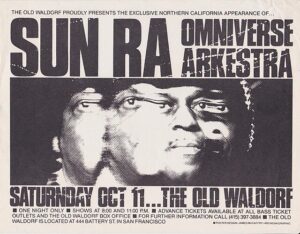
The genesis of his overarching, exotic, mind-blowing performance artifice was a spontaneous “comic vision” he experienced as a 20-something college student in the mid-1930s. That timeframe is significant because it means that Sun Ra predated everything that would come to shape the “UFO-O-Sphere” in the decades following the advent of the “flying saucer” era that began with Roswell and Kenneth Arnold (my fellow native small-town Minnesotan) and his sighting of a UFO fleet over Mount Rainier in 1947.
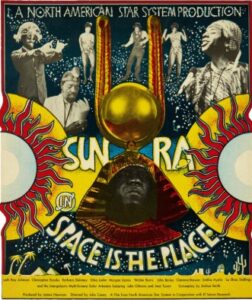
I strongly recommend viewing Sun Ra’s utterly fantastic 1974 movie, Space is the Place, which you can watch free on YouTube HERE. It’s great!
Fiorito astutely recognized that Sun Ra’s vision transcends the “nuts-and-bolts” definition of UFO reality that would dominate the UFO community for decades to come, and only recently has given way to the reimagining of ufology by the likes of McKenna, Valle, Jung, John Keel, John Mack, Greg Bishop, Whitley Streiber, Keith Thompson, and now many relative new comers, (such as Yossi Ronen, Terry Lovelace, Erin Montgomery and Kevin Cann).
(Note: Click on the names linked above to see my book reviews of these authors here on Medium).
A Fiorito favorite, the British progressive rock band, Yes, is infused with a UFO connection that was a steady influence on their music. One of the band’s songs, “Arriving UFO,” was a selection on the Yes 1978 album, “Tomato,” is a direct example. However, it is probably more accurate to say that UFO themes were an understated, latent motif that added color and dimension to this group’s overall musical vision.
Of course, Pink Floyd is a group that can be considered significantly “UFO-adjacent” in terms of concepts and influence, and this connection is both direct and complex. Some of their early songs, such as “Let There Be More Light,” reference alien-human contact. Other songs describe alien landscapes (“Astronomy Domine,” for example).
One of the coolest Pink Floyd connections is that these giants of visionary, often acid-inspired rock were the “house band” for London’s notorious UFO Club in 1967. The UFO Club has been described as “the epicenter” of the UK’s psychedelic counterculture. It was known for its “trippy light shows,” cutting-edge, experimental music and art, which included electric light shows presented mostly in planetariums.
(Side note: I remember going with some friends to view the Pink Floyd Laser Light show in 1978 — it was presented in the planetarium at Moorhead State University in Moorhead, Minnesota.)
A REMARKABLE RIGHT-BRAIN, LEFT-BRAIN SYNTHESIS
Mike Fiorito writes a lot about the magical, mystical and the psycho-boundary-smashing power of music — but when he needs to, he finds his left-brain analytical mind and applies it to analyzing the techniques that groundbreaking musicians have leveraged to create new masterpieces of innovative music.
I’ll give you an example. In describing the musical arts of Pink Floyd, Fiorito opts to describe the use of a specific piece of equipment called the Azimuth Coordinator. He writes:
“The Azimuth Coordinator was the first passing control designed for a quadraphonic sound system — a groundbreaking concept at the time. Pink Floyd was the first band to use it in their early live performances, pioneering a new dimension of concert sound … the device consisted of four rotary rheostats housed in a large control box. These rheostats, originally designed for 270 degrees of rotation, were modified to function within a 90-degree range, dictated by the physical limits of the control lever and the aperture on the box’s surface. The system was operated using two joysticks, allowing sound to be panned across up to six loudspeakers strategically positioned throughout the venue.”
Here’s just one more example wherein Fiorito is offering an analysis of the music of the great Brian Eno:
“Eno arranged his instruments like a sorcerer preparing a ritual — a synthesizer with a memory, a looping spell of tape delay … the linear notes whisper the alchemy: two melodic phrases, unequal in length, summoned from the digital soul of the EMS Synthi AKS — a machine with a sequencer rare for its time. The tones passed through a graphic equalizer, their timbre shifting the light through stained glass, then echoed, layered and looped between twin tape machines, each pass a ghost of the last, each repetition, a memory enfolding into itself.”
How marvelous! I found it amazing how Fiorito makes his wonky techno-analysis of Eno’s methods read like avant-garde prose poetry! It reminds me of that line from a song called Spirit of the Radio by the Canadian prog-rock band, RUSH:
“All this machinery making modern music can still be open-hearted…”
Anyway, I’ll end my review here, albeit with some regret because I necessarily have to leave so much on the “cutting room floor.” But that’s okay; a good reviewer shouldn’t give too much away. Those who have not yet read the book will have much more to discover.
I’ll note that, if you are like me, always starving for new UFO fodder, Fiorito includes several intriguing and fascinating UFO encounters as told to him by people he interviewed. I enjoyed these stories to the Nth Degree!
A FINAL COMMENT
The Innerspace of Outerspace clocks in at just under 200 pages, but I believe this book stands with Douglas Hofstadter’s 900-page behemoth and Pulitzer Prize-winning 1979 book, Gödel, Escher, Bach: An Eternal Golden Braid, (which seems like it took me half of the 1980s to read from first page to last!)
Hofstadter’s remarkable tome explores the connections between mathematics, art, and music through the works of logician Kurt Gödel, artist M.C. Escher, and composer Johann Sebastian Bach.
Mike Fiorito does it his own way — with innovative assists from Tarot, Qigong, psychedelics & more — and his book bears a resonance with Hofstadter’s brilliant and groundbreaking classic.
JOIN ME ON BLUESKY: KEN-ON-BLUESKY
NOTE: For more stories about UFOs and all things paranormal, please see: KEN-ON-MEDIUM