
 By KEN KORCZAK
An innovative framework invites us to perceive the genuine reality of the UFO phenomenon by looking deeply into ourselves & reimagine what it means to be alive, aware and to experience.
“What came first, the soul or the UFO?” — Kevin Cann
That question posed by the nuclear engineer, IT architect, philosopher and author Kevin Cann is another indicator that we have entered a “Golden Age” for the study of the UFO issue. It’s a marvelous time for those of us who live and breathe “all things UFO” morning, noon and night.
Thankfully, we are finally emerging from the long-standing “nuts-and-bolts” perspective of what UFOs are and moving on from endless Rube Goldberg conspiracy theories that muddy the waters and do little to illuminate the reality behind UFOs.
Also heartening to me is that a new class of UFO theorists is jumping into the fray and making marvelous contributions. These are serious, mainstream philosophers and academics who have recognized that UFOs are a legitimate, worthy subject, arguably among the most important inquiries humanity can grapple with today.
I’ll mention three just academic philosophers of recent note:
· Dr. James Maden, a professor of philosophy at Benedictine College. His book, Unidentified Flying Hyperobject, has been well-received by the public and scholars alike.
· Dr. Peter Skafish, a sociological anthropologist who has held research positions at UC Berkeley, Collège de France, McGill University, and the Bauhaus-University in Weimar, Germany. Dr. Skafish is a co-founder of a “UFO think tank” called the Sol Foundation. His book: Rough Metaphysics.
· Dr. Jason Reza Jorjani, a brilliant, albeit controversial philosopher formerly of the New Jersey Institute of Technology and now a prolific author. His book Closer Encounters has been called “an important discussion of humanity’s cosmic origins and evolutionary destiny.”
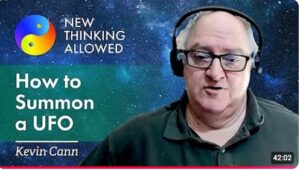
Kevin Cann is a former U.S. Navy nuclear engineer who supervised reactor operations aboard the USS South Carolina for eight years. A military veteran who has logged 31 years as an information technology architect, Kevin Cann also developed security and identity systems for an array of A-List clients, including the University of California and corporate entities.
Furthermore, Kevin Cann has something more that sets him apart. He happens to be a “UFO experiencer,” and he also gained insight early in his life from an NDE, a near-death-experience.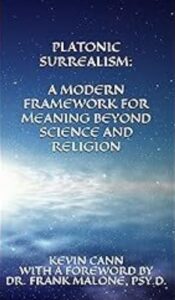
So, what we have here is a dude with a rare combination of a honed scientific, technical and analytical mind — balanced and informed by his embrace of right-brain, nonlinear cognition, and the latter is enhanced by his personal, lived experiences with “paranormal” encounters.
That’s why I am so delighted today to tell you about Mr. Cann’s new book, Platonic Surrealism.
A FRESH SYNTHESIS OF NEW & ANCIENT PHILOSOPHIES
Platonic Surrealism is a book designed to help people realize a more expansive, imaginative, joyful, transcendent and illuminated life, while it also seeks to demystify some of the most key and fundamental mysteries of our existence.
I am inclined to define this book as “a handy roadmap to understand & navigate the reality we perceive,” or more generally, as “an instruction manual for the human race.” It is certainly a work of philosophy, but it might also be called a “self-help book.”
However, I am loath to apply any definitions because the moment you “name something,” you also limit it. In a sense, this is a book that defies category. But let’s not worry about that right now or overthink it. That’s because I can tell you that:
Platonic Surrealism is a book written with an enormous amount of heart, balanced with a healthy dollop of intellectual rigor, but best of all, penned with an engaging (sometimes even funny and “quirky”) style that makes it an enjoyable read for just about anyone.
I hasten to add that it accomplishes the latter without “dumbing down” lofty philosophical concepts. Kevin Cann has no qualms about challenging his readers to think. To that end, I gather that some readers will have to “work at” understanding at least some or many aspects of what is described and/or modeled in these pages.
On the other hand, many readers will resonate as smoothly as electrons flowing through a superconductive wire as they engage with the elegant, cross-disciplinary ideas Mr. Cann spells out in his book. (Count me in this category!)
Platonic Surrealism reminds me of that often-paraphrased quote of Albert Einstein:
“The goal of all theory should be to make it as simple as possible — but not too simple.”
Platonic Surrealism is a book that demonstrates Einstein’s axiom extremely well.
A GRAND INVITATION
Author Kevin Cann invites his audience to think differently, to see ordinary things in a new way. Sure, this book necessarily trucks in some of the thorniest issues of perception, intellect, emotional energy, meaning, epistemology, interpretation, cosmology, consciousness, awareness, transcendent experience, and more — but the payoff will be enormous for those readers who just “bear-with” and come along for the ride with an attitude of curiosity and openness.
Yes, this is a slim volume, but with an ambitious goal. It endeavors to clear a path for people, showing how they can transcend the drudgery of a daily, mundane life to navigate reality in a way that is meaningful, joyful, chock-full of adventure, and infused with an all-permeating bath of warm love.
One of the reasons that I instantly recognized Platonic Surrealism as an “Instant Classic” is that many of the ideas presented here are steeped in paradox. Paradoxes can seem vexing, but they are a clue pointing to hidden synchronistic resonances that can trigger flashes of illumination.
Resolving a paradox can deliver those rare but indescribably pleasant “Ah-ha” moments of sudden transcendent discernment and perception.
Furthermore, Mr. Cann demonstrates that he has grasped that our “common sense” view of reality is laboring under an array of cunning misconceptions or delusions, but he is determined to help us recognize these “traps” and offer us workable solutions. More on that in a bit, but first …
A BRIEF ASIDE
Speaking of “cunning delusions,” I’m now going to go briefly off script to select just one of these “delusional generators” and explain it. I believe doing so will help ease the anxiety of any reader of Platonic Surrealism who might be stymied by certain terms or definitions leveraged by the author in this book.
What I’m talking about is the fundamental problem with language itself. Philosophers, notably Ludwig Wittgenstein, have long agreed that words, phrases and sentences can only convey an approximate meaning of what they attempt to describe, convey, illustrate, or explain.
Although he does not address this issue directly, it’s clear that Kevin Cann is cognizant of this “language barrier” factor because I noticed several passages in this book where he touches upon it tangentially. A good example of this is where Mr. Cann describes one of his practice exercises called the “One Breath Eye Tracing Practice.” More on the latter in a bit.
My aside continues …
REALITY SUSPENDED IN LANGUAGE
In addition to the work of Wittgenstein, the notion that our “reality is suspended in language” is illustrated by the Sapir-Whorf Hypothesis, which states:
Language determines thought and limits cognitive capabilities. This argues that if a language lacks a word for a concept, its speakers cannot comprehend that concept.
The strong version of Sapir-Whorf is:
Linguistic Determinism: Language determines thought and limits cognitive capabilities. This argues that if a language lacks a word for a concept, its speakers cannot comprehend that concept.
The weak version is:
Linguistic Relativity: Language influences thought, making certain ways of thinking more habitual or convenient.
An additional outcome of Sapir-Whorf is:
“Reality” is rendered as a Social Construct: That is, what we commonly take for “reality” is not an objective, fixed entity, but rather a “constructed” experience shaped by words, labels, and categories.
(Note: I like to think of Sapir-Whorf as the “linguistic cousin” of Kurt Gödel’s Incompleteness Theorem for math and logic, which states that all sufficiently complex mathematical systems are inherently incomplete.)
Anyway … (my aide continues) …
The reason I took the pains to explain Sapir-Whorf is that I want readers to understand that, if or when you come to a part of Kevin Cann’s book that doesn’t “quite register” comfortably with your sense of familiar recognition, there’s a good chance it’s due to the limitations of language.
I’ll mention one additional aspect of the language limitations I have described above, and this one comes by way of the great Swiss psychologist Carl Jung.
Jung pointed out that, when one person communicates a message to another person, that information will be “filtered through” the “worldview” of the individual on the receiving end. In other words, no matter what you write or say to someone verbally, that person will “take it in and make it their own” via their own “interpretation process.”
The result is that “the message” never arrives at its destination in precisely the same form that perfectly reflects the precise meaning and intent of the sender. This is why it seems that people often “talk past each other” and so on. Of course, at other times, people understand each other quite well — albeit it generally so — and so forth.
So, if there is something you can’t wrap your mind around in this book comfortably right away, take Kevin’s often-suggested advice: “Don’t fret about it.”
Just read on and get the whole book ingested, first by your intellect, but then let it percolate through the other aspects of your “beingness,” from your “emotional IQ” to the latent, “nonlinear aspects of your awareness” that you use all the time, whether you are aware of it or not.
(Note: I have developed a “special hack” that I call “Reading the Energy of a Book.” It’s a way to extract “meta-information” that is embedded or “hidden” within the structure of language within a document. My hack involves an intent to focus on the “empty spaces” between the words, where I believe “latent meta information” can be leveraged for deeper understanding. I won’t be going into that today, however, because I want to focus on Platonic Surrealism. But I’ll write about my “hack” in a future article).
But again, whatever the case, it bears repeating what Kevin Cann likes to say, “Don’t fret over it.”
(End of Aside)
PLATONIC SURREALISM DEFINED
Kevin Cann explains that he is “the founder” of Platonic Surrealism, and he defines it this way:
“A philosophical and experiential framework. Platonic Surrealism (PS) integrates elements of Neoplatonism, Neutral Monism, and Analytical Realism with contemporary scientific concepts … its aim is to provide a comprehensive understanding of reality that also serves as a tool for personal healing and the actualization of human potential.”
Then:
Mr. Cann tells us that there are several “fundamental concepts” at the core of Platonic Surrealism. These define the cosmology of PS. I will name them, but I won’t explain them here. You’ll have to read the book for that. Anyway, the core concepts are:
1. Potentially
2. Awareness
3. Primordial Consciousness
4. Fractured Consciousness
5. Dream Substance
6. The Pain Self
7. The Transcendent Self
Added to this, Mr. Cann intriguingly tells us that, as human beings, we have “five brains,” also called “The Five-Fold Interface System”. These are:
1. The Left-Brain Hemisphere or “the microscopic pain ego.”
2. The Right-Brain Hemisphere or “the macroscopic transcendent ego.”
3. The Enteric Nervous System or “The Storage Location for the Shadow.”
4. The Bioplasma Storage Interface.
5. The Monadic Network in the Pleroma Interface.
I found it enjoyable as Kevin provided his readers with vivid definitions of each core principle. These add dimension and flesh out his vision of Platonic Surrealism. As I integrated with the context of the “Five Brains” scenario, I waxed even more comfortable and felt better equipped to understand PS in a practical way.
Learning the “functions and purpose of the “Five Brains” adds meat to the bones of the core principles of Platonic Surrealism — it helped me look into myself for comparisons about how I had already been interacting with some of these interfaces over the years of my own consciousness exploration adventures, even if I had been using different terms to define them.

The Five Brains also brought me a freshly-minted perspective on the nexus linking the subjective aspects of mind/consciousness/awareness with the basic physical matter “stuff” that composes human bodies.
SIMPLE AND PRACTICAL EXERCISES TO TRIGGER TRANSCENDENCE
After he has laid out the groundwork for Platonic Surrealism, Kevin Cann gets practical and offers Ten Practices readers can take for a test drive.
I love the names of these methods for the very reason that, to me, they “sound so groovy,” bearing a definite Thaddeus Golas sort of vibe. Some of them are:
· Breath Eye Tracing Practice
· Unbound Star Practice
· 10,000-Foot-Tall Ego Practice
· Liquid Heart Practice
· Hurt Child Hugging Practice
· Interface Ack Practice
· Aplomb Practice
I mean, when you hear about something called an “Interface Ack,” practice, you’re just going to want to try that, right? I know I did!
I’M ONLY SCRATCHING THE SURFACE BUT …
Platonic Surrealism clocks in at just 134 pages (in my Kindle reader version), but I would have to write on for dozens more pages to provide a complete inventory of all that’s packed into this volume. Be aware that there is much I have not covered.
This book reminds me of a neutron star, the remnant of a supernova. Astronomers tell us that just one teaspoon of a neutron star would weigh 6-billion tons (in Earth gravity terms) because of the extreme density of its core. In a similar fashion, every chapter of Platonic Surrealism “punches above its weight.”
At any rate, I hope the brief review I’ve provided will whet the appetite of the reader for more. I encourage all to punch a ticket for a full ride on this new philosophical framework that doubles as a practical, hands-on guide that just might — maybe, it could happen, there’s a good chance, probably will— make your life more magical, imaginative, meaningful and fun!
JOIN ME ON BLUESKY: KEN-ON-BLUESKY
NOTE: For more in-depth stories & analysis of UFO issues, please see: KEN-0N-MEDIUM