
 KEN KORCZAK
A Corporate Legal Ace Documents His Past Lives as Several Historical Giants
A favorite attack line by skeptics of reincarnation is:
“Why do people always claim to be reincarnated from someone famous, like an ancient Egyptian queen or a Native American warrior or shaman?”
Indeed, this notion is so baked-in, it was used as a laugh line in the 1988 film Bull Durham, starring Kevin Costner (Crash) and Susan Sarandon (Annie). Here is the exchange from that flick:
Annie: I think probably with my love of four-legged creatures and hooves and everything, that in another lifetime I was probably Catherine the Great, or Francis of Assisi.
Crash: How come in former lifetimes, everybody is someone famous?
(They both laugh).
Crash: I mean, how come nobody ever says they were Joe Schmo?
(More laughter).
Annie: Because it doesn’t work that way, you fool!
The reality, however, is that anyone who has studied reincarnation knows that only a tiny percentage of people who report memories of past lives believe they were previously famous.
An overwhelming majority (probably something like 98.7%) of people who recover past life memories find they were, indeed, just that — an average “Joe or Jane Schmo.” Nevertheless, these lives are deeply meaningful to them.
(Note: A couple of famous exceptions are World War II General George Patton, who believed he was the reincarnation of Hannibal, the 3rd-century BC military genius of Carthage, and rock legend Tina Turner, who claimed to be the reincarnation of the powerful Egyptian queen, Hatshepsut.)
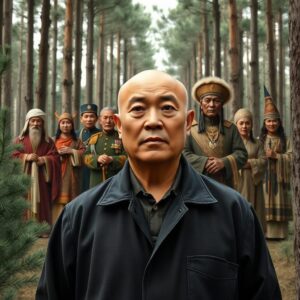
But now I will discuss a man who flips the script, so to speak. That is, he is not a widely well-known person today, but the list of past lives he claims reads like the ultimate “A-List” of super-famous historical figures.
His name is Kelvin Chin.
Get this:
Kelvin Chin believes his “soul” has returned from death and returned to Earth hundreds or maybe thousands of times, and some are famous indeed. His past lives docket includes:
SIMON PETER — Yes, that Simon Peter — the apostle closest to Jesus, who later was canonized as Saint Peter and is considered the “First Bishop of Rome.” Jesus changed his name from Simon to Peter because the latter means “The Rock.”
Simon Peter died and was reborn as:
MARCUS AURELIUS — Emperor of Rome from 161 AD to 180 AD. Known as a “Philosopher King,” Aurelius was dubbed one of the “Five Good Emperors of Rome” by Niccolò Machiavelli. Aurelius is equally revered by history as a great Stoic philosopher. His published “Meditations” is a classic of the ages.
Emperor Aurelias died and was reborn as:
RICHARD I (Richard Lionheart) — King of England, 1189–1199. Among the most brilliant medieval military tacticians who led a massive force to the Middle East on the 1189 Third Crusade. Son of Henry II.
Richard Lionheart was killed after being struck by an arrow in 1199. But he was then reborn as:
FREDERICK THE GREAT — Arguably the greatest monarch of Prussia, ruling from 1740 to 1786. Often compared by historians to Marcus Aurelius for his combination of military genius and wide-ranging intellectual interests. Frederick was a significant figure of the Enlightenment.
After a long and brilliant life, Frederick died and came back again as:
SITTING BULL — The Lakota war chief who defeated General Custer at Little Bighorn and led the resistance of several Great Plains tribes against the United States military. Sitting Bull was also known to be a powerful shaman or medicine man. Sitting Bull was born in 1831 and murdered by U.S. agents in 1891.
After Sitting Bull was shot in the head out on the Great Plains of North Dakota, he eventually found his way back to another Earth-bound existence. His next life was that of a World War II fighter pilot whose airplane was gunned down in flames when he was just 23 years old. Then, after about eight years in the After Life, the WWII pilot (who was previously Sitting Bull) was reborn as:
KELVIN CHIN, the author of this book, After the Afterlife, which I am reviewing today.
It is important to note that, in addition to giants of history, Chin writes about numerous other past lives that occurred before and in between his manifestations as famous people, most of them “ordinary people.” For example, he recalls a life as a lowly Carthaginian galley slave, several lives as rank-and-file Buddhist monks, a Babylonian soldier, an anonymous woman, and more people from everyday walks of life.
In addition to experiencing the lives of ordinary people, Chin has also recalled reincarnating as:
· An alien being on another planet
· An eagle
WHO IS KELVIN CHIN?
Mr. Chin was born in the early 1950s in Boston to parents with a background in materials science. His father earned a degree in mechanical engineering from Northeastern University, and his mother graduated from the University of Boston with a degree in chemistry.
Their son, Kelvin Chin, excelled academically in high school and was already fluent in French when he was accepted at Dartmouth College. While an undergraduate, he also studied at the Université de Strasbourg in France. He then went on to Yale for graduate school and topped off his education with a law degree from Boston College Law School.
Chin then embarked on a distinguished career in senior corporate and legal roles. Along the way — and significantly — he learned Transcendental Meditation (TM) by studying directly under another notable figure from recent history — the Maharishi Mahesh Yogi, founder of the TM movement.
A non-religious person, Chin originally signed up for TM for purely practical reasons. He began experiencing severe anxiety as a Sophomore at Dartmouth, and he hoped learning meditation would help him calm down and cope.
Chin impressed the Maharishi and became adept at Transcendental Meditation, so much so that he climbed the ranks of the organization quickly. That helped him become an important international leader within the global TM infrastructure.
Again, Chin was not interested in “the woo-woo” aspects of meditation. Few people might be aware that the TM organization actually separates the spiritual or “paranormal” aspect of its overall mission from other, more practical & functional elements. The latter might include using meditation to make corporate employees more efficient & productive; help athletes train, focus and excel with performance; as a clinical tool for psychologists to treat people for anxiety, stress, depression and similar problems.
So, it came as a gigantic surprise to Chin that, as he got deeper into his TM practice, he began to experience wholly unexpected and spontaneous memories of past lives — again, something he had previously always believed to be ridiculous nonsense.

HARD TO BELIEVE?
Asa person interested in “all things paranormal,” I’ve paid attention to the reincarnation issue for decades. While I’m convinced of the reality of reincarnation, I admit I’m deeply suspicious of people who claim to be the returned souls of “powerful Egyptian priests” or “Native American shamans/warriors,” or hugely famous individuals.
In fact, I grew up in an area with a significant Native American population, and (although I’m a “white guy,”) I formerly taught a college course called “Indians Into Journalism” at the University of North Dakota. One of the things my indigenous friends, neighbors and students told me quite often is that they found it irritating when “white people” told them, “I was an Indian in a past life.”
Indeed, more than a few of my Lakota and Ojibway associates have said to me: “Whites claiming to be reincarnated Indians is something we hear all the time.” Some added that they found this “condescending,” and they sometimes suggested it might also be a mechanism to assuage “white guilt” over the Eurocentric genocidal policies against Native peoples.
So, as I read the story of Kelvin Chin and his eye-popping claims of being reincarnated from a string of historical giants — including one the greatest Native American heroes — my credulity was strained to the limit.
As I turned pages, and every time I got to the next blockbuster luminary from history, I began to guffaw and balk — I mean, Simon Peter! Sitting Bull! Richard Lionheart! — and the others? More than once, I reached my “Oh come on!” moment!
But then … what nagged at me was that, in researching Mr. Chin’s background, I found him a person of impressive accomplishments, both academically and in practical application. More than that, his extracurricular pursuits show him to be a person of heart. His nonprofit efforts demonstrate a genuine caring for his fellow human beings, along with a love for our Planet Earth and all its creatures and lifeforms.
Furthermore, his writing style projects an aura of humility. His prose is unpretentious and sprinkled with endearing colloquial usages — the latter imparts a sense of down-to-earth authenticity. His narrative moves along with a natural rhythm that’s unassuming and respectful to the intelligence of readers.
I ENDED UP BELIEVING KEVIN CHIN
So, despite his audacious claims, I found myself won over by Kelvin Chin by the time I turned the last page of his book. Several factors convinced me (almost) that it may be possible that this man is the many-times returned soul of everyone from Simon Peter to Sitting Bull. These are:
1. Well-Researched Context
Chin provides a detailed analysis of the personalities of each of the famous people he claims as his own reincarnational progeny. He demonstrates how central aspects of their world views, goals, and the way they walked through history seem to demonstrate a common goal, a blended thread, a logical extension from one to the next that would seem to be a carefully thought-out strategy of an “Over Soul” seeking to accomplish specific tasks within the material-physical-bound theater that is “The Earth School.” Or let’s call it that Virtual Reality Matrix that can be entered into by the avatars of nonphysical beings (you and I) as we all seek to evolve the quality of our consciousness by playing “The Game of Life on Planet Earth.”
2. Caveats and Acknowledgments
Chin addresses the scientific provability of reincarnation theory and acknowledges that solid scientific proof has not been achieved to satisfy “hard science.” Chin writes:
“I know it may be difficult for some people to accept (reincarnation) … and as I’ve said, that is not why I have written this book, I’m a teacher, not a preacher. My objective is not to convince or to change people’s beliefs, but instead to propose a different perspective to consider — to create a lens for each of us to look through …
… by creating these various lenses, I endeavor to filter my own experiences in a way that makes sense, informs and explains, and ultimately teaches … still, I question everything. I do not blindly follow even my own ideas. I am not married to the conclusions I’ve come to about who or what I may have been in these past lives.”
3. Third Party Confirmations
Kelvin Chin provides some extraordinary “third-party” confirmations to show his string of past lives as famous people may be true. One of the most intriguing examples he details is a lecture given by a successful businessman by the name of Charlie Lutes. Lutes was among the first Americans to learn TM directly from the Maharishi, and Lutes later became the first “World Governor” of the TM organization.
Anyway, Lutes gave a lecture in Los Angeles in 1973, during which he made an extraordinary claim. He told his audience that there was a person who was “currently a teacher in the TM organization,” and that this person was the “reincarnation of both Simon Peter and Frederick the Great.”
The kicker is that Kelvin Chin and Charlie Lutes did not know each other, and they never met. Furthermore, Chin did not begin to spontaneously recover reincarnational memories until 1977, four years after the lecture of Charlie Lutes! Chin also never heard or read a transcript of the Lutes lecture after the fact. Yet, Charlie Lutes somehow knew that Simon-Peter-Frederick-the-Great-Kelvin-Chin was a current member of the global TM organization. This turned out to be correct.
Skeptics might reasonably suggest that Kelvin Chin obviously read a transcript of the Charlie Lutes lecture and latched on to the Simon Peter-Frederick the Great connection and then adopted it into his own reincarnation narrative four years after the Lutes comments. But Chin says this is not the case.
There is a lot more to this story, and it’s better understood if one reads the full context of this story in Chin’s book. Chin offers other kinds of “outside confirmations” if his various past lives. If these examples are not totally convincing and will not satisfy skeptics, I challenge readers to decide for themselves if they read the book.
OTHER ISSUES
As I said near the beginning, I’ve studied reincarnation for decades, and I would love to discuss other theories of the phenomenon — such as the suggestion that “past lives” are not really that — in the past — but rather, all of our incarnational connections are “simultaneous lives.”
The best description of the simultaneous lives model was articulated by Seth, the disincarnate entity channeled by the great Jane Roberts. I recommend The Nature of Personal Reality, a book written by Seth as channeled through Jane Roberts.
Google AI does a decent job of encapsulating Seth’s concept of simultaneous time:
“Seth … explained simultaneous time as a non-linear reality where past, present, and future exist at once, with our perception of flow being a construction of consciousness, not a universal flow; our beliefs and focus create our experienced reality, and time is a dimension to be navigated, not just a river, with each moment holding infinite possibilities, emphasizing the present as the point of power for creation, not a fleeting instant.”
Another interesting way to model reincarnation is that what is really happening when a person taps into past life memories is a situation in which our minds or consciousness “intersects” with the “ambient world view” — or perhaps “archetype concepts”— associated with people only perceived to be “behind us in time.”
This latter theory solves a lot of the thorny problems that still vex the supporters of reincarnation theory. When you take the “simultaneous time” concept and combine it with the idea of interfacing with archetypal energy-information models — much about reincarnation begins to make more sense, while also bringing it in line with a quantum view of reality as opposed to a classical physics view in which time is modeled as a “one-way arrow” moving from past toward the future.
But all this is for another article, so I’ll stop here and close by saying I strongly recommend Kelvin Chin’s After the Afterlife as an intelligent, well-written book that will fascinate and entertain open-minded readers.
JOIN ME ON BLUESKY: KEN-ON-BLUESKY
NOTE: For more in-depth review of the best paranormal books, please see: KEN-ON-MEDIUM